Tesla-SpaceX Merger Odds Hit 70% On Kalshi After SpaceX’s Post-IPO Rally
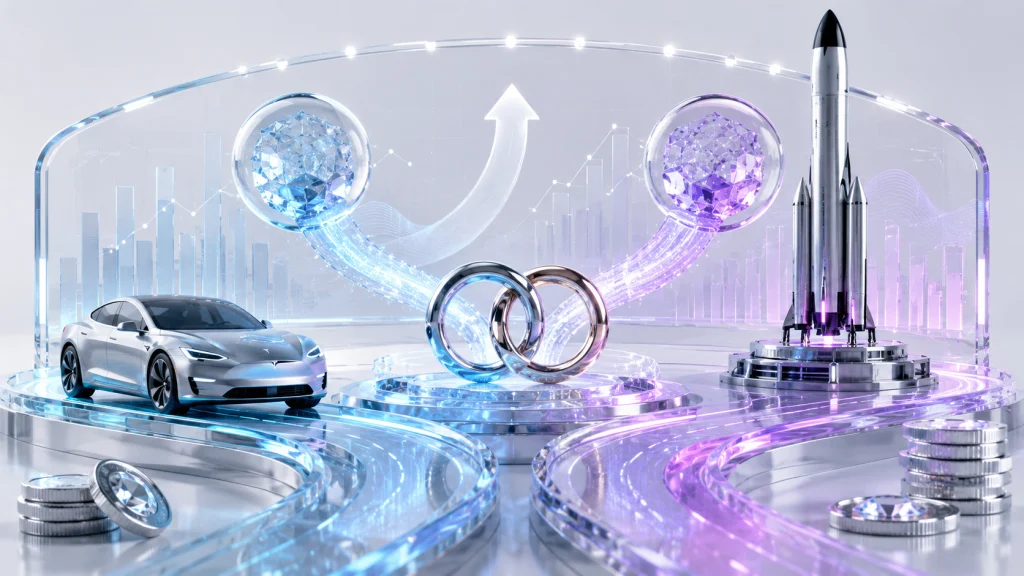
Prediction-market traders have priced a 70% chance that Tesla and SpaceX announce a merger or acquisition agreement before the end of 2026, after SpaceX’s post-IPO rally turned Elon Musk’s rocket company into one of the world’s largest public companies.
The Kalshi contract requires a definitive, binding agreement involving Tesla or SpaceX before the deadline. Informal comments, market speculation, analyst notes, preliminary talks, or loose corporate overlap do not settle the contract unless an official merger, acquisition, combination, or controlling-ownership transfer is announced.
SpaceX priced its record public offering at $135 per share, raising $75 billion and valuing the company at roughly $1.77 trillion at the IPO price. The stock then surged in public trading, briefly reaching the $218 area before pulling back toward the mid-$180s, leaving SpaceX with a market value still near the $2.4 trillion range.
That trading path has made the merger bet more concrete. The question is no longer only whether Musk’s companies share strategy and supply chains. Traders are now pricing whether Tesla’s public-shareholder base, SpaceX’s new public valuation, and the companies’ overlapping AI, energy, robotics, satellite, and manufacturing ambitions can be turned into a formal deal structure.
Tesla Links Give The Trade A Strategic Hook
The merger thesis rests on real operating overlap. SpaceX has used Tesla energy hardware, including Megapack batteries, while Tesla’s future story depends heavily on AI, robotics, manufacturing scale, energy storage, and autonomous systems. SpaceX’s public-market narrative now stretches beyond launches and Starlink into defense, AI infrastructure, orbital data centers, and high-capacity satellite communications.
Wedbush analyst Dan Ives has been one of the clearest bulls on the idea, placing the probability of a Tesla-SpaceX combination above 80% by 2027. His case centers on the view that Musk is building a single industrial AI stack across mobility, energy, space connectivity, chips, robotics, and compute infrastructure.
SpaceX’s market debut has already spilled across crypto-adjacent trading rails. SpaceX-linked exposure helped drive record tokenized stock activity on Solana, while SpaceX-related contracts helped push prediction-market volume to a record $10.8 billion week. The same equity story has also tested liquidity after SPCX erased nearly $500 billion from its early peak, showing how fast the valuation can move when float, index demand, and retail appetite collide.
The capital-markets angle is still expanding. SpaceX bankers are also preparing a possible bond sale of at least $20 billion, a move that would extend the company’s financing push beyond the IPO and into the debt market as investors weigh its launch cadence, AI spending, and infrastructure plans.
Deal Hurdles Remain Heavy
A Tesla-SpaceX merger would be complicated even before price enters the discussion. Texas corporate law generally requires approval from holders of at least two-thirds of outstanding shares for certain fundamental transactions, unless company documents provide a different permitted threshold. Tesla’s public float makes that approval process more demanding than a private negotiation between Musk-controlled entities.
Valuation would be another pressure point. SpaceX is now trading at a massive public-market premium, while Tesla shareholders would need to judge whether any merger exchange ratio fairly reflects Tesla’s own AI, energy, vehicle, and robotics upside. A transaction would also raise governance questions because both companies are closely tied to the same founder, and outside shareholders would expect independent review, fairness opinions, and clear conflict controls.
National-security review could be just as important. SpaceX handles NASA missions, Starlink connectivity, defense-related satellite work, and launch contracts tied to U.S. strategic infrastructure. Any consolidation with Tesla would likely be examined through procurement, antitrust, foreign-ownership, defense-contract, and operational-continuity lenses.
Musk Keeps Reusability At The Center
The merger debate arrived as Musk sharpened SpaceX’s broader competitive pitch against Europe’s launch industry. After a Financial Times feature on Ariane’s fight to stay relevant against SpaceX, Musk argued that legacy launch providers need reusable rockets or risk falling behind the cost curve that made Falcon 9 dominant.
Europe’s Ariane 6 is gaining momentum. Arianespace successfully launched 36 Amazon Leo satellites on June 17, using an Ariane 64 configuration with advanced boosters. The rocket has restored heavier European launch capacity, but it remains partly expendable, while Europe’s fully reusable ambitions are still tied to future systems.
SpaceX’s advantage remains its reuse history and cadence. Falcon 9 first-stage reuse began after the first orbital-class booster landing in 2015, and SpaceX has since built a launch model around recovering and reflying major hardware rather than treating each mission as a one-off vehicle. That cost structure supports Starlink deployment, NASA missions, commercial launches, and defense work, all of which feed the valuation investors are now attaching to SPCX.
Musk’s reusability push does not make a Tesla-SpaceX merger automatic. It does explain why traders are willing to price the possibility aggressively: SpaceX is now a public-market giant with a hard-to-replicate launch network, Tesla is still the listed company most tied to Musk’s AI and energy ecosystem, and Kalshi’s contract now turns on whether that strategic overlap becomes a definitive deal before the 2026 deadline.