Binance Research Says Blockchain Transparency Is Trapping Dirty Crypto On-Chain



Binance Research is pushing back against the idea that crypto is mainly a money-laundering tool, arguing that public blockchains have made illicit funds easier to trace, freeze, and seize than many traditional financial flows.
The firm’s latest X thread framed blockchain transparency as a growing problem for criminals rather than a shield for them. The core claim is direct: illicit crypto activity sits below 1% of total transaction volume, while more than $75 billion in dirty funds remains visible on public ledgers.
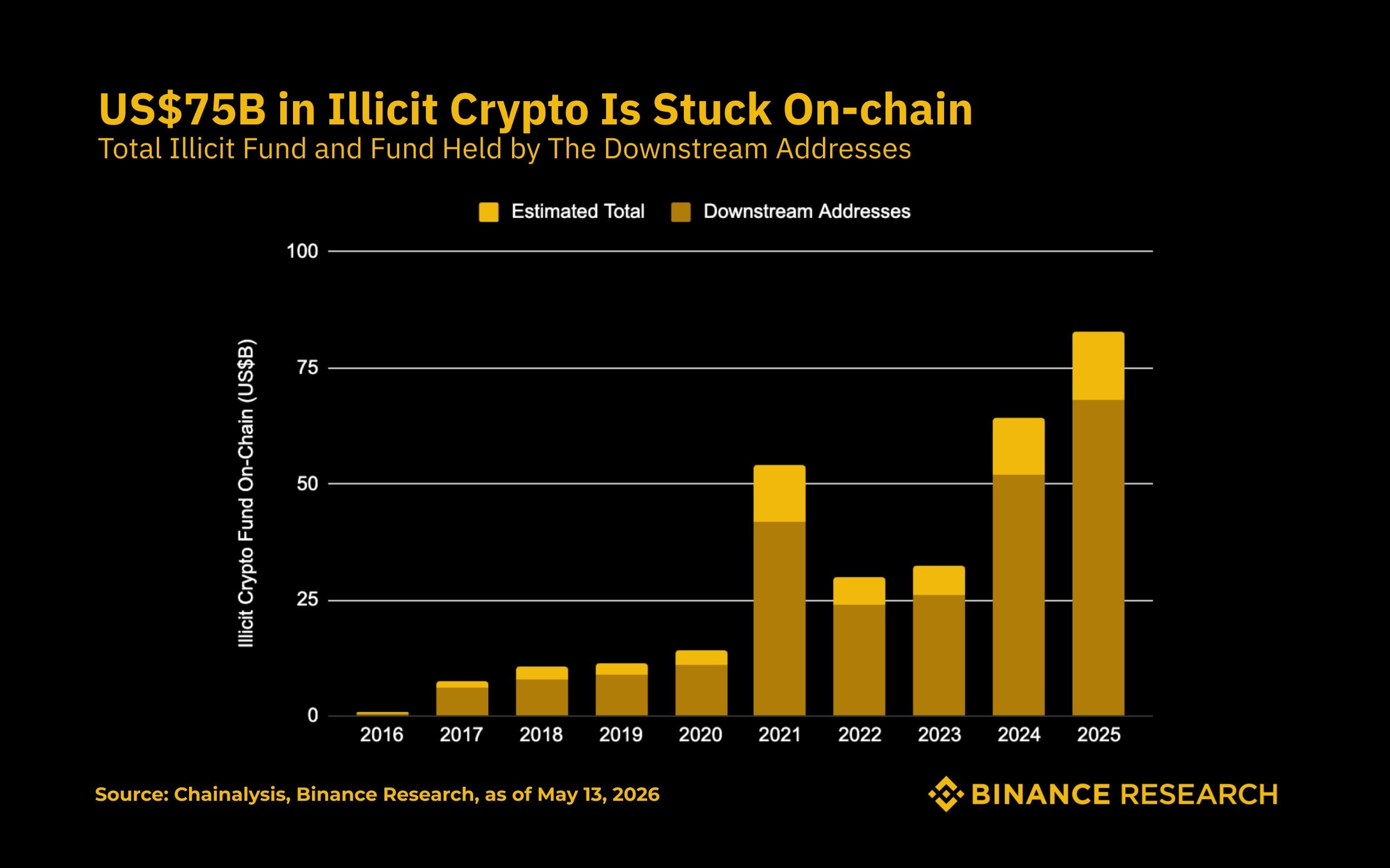
That framing is backed by recent blockchain analytics data, but it needs balance. Chainalysis’ 2026 Crypto Crime Report estimated that illicit addresses received at least $154 billion in 2025 and said the illicit share of attributed crypto transaction volume remained below 1%. TRM Labs put illicit crypto flows even higher at $158 billion for 2025, while estimating the share of total attributed on-chain volume at 1.2%.
The numbers tell two different stories at once. Crypto crime is small as a share of total blockchain activity, but it is still large in absolute dollar terms. That is why the transparency argument is not a denial of risk. It is an argument that crypto crime leaves a permanent trail.
More Than $75B In Illicit Balances Remains Visible
The $75 billion figure comes from Chainalysis’ seizable-assets analysis, which examined balances sitting in wallets tied to illicit activity rather than only measuring transaction flows. The firm estimated that illicit entities directly hold nearly $15 billion in BTC, ETH, and stablecoins, while downstream wallets linked to those entities hold more than $60 billion.
Chainalysis also said darknet market administrators and vendors alone control more than $40 billion in on-chain value. Bitcoin remains the largest asset in those balances, representing about 75% of illicit entity holdings, partly because older stolen or criminally linked BTC has appreciated over time.
Those static balances help explain why blockchain transparency can turn into a trap. A bank transfer may disappear into layers of intermediaries, shell companies, or cash channels. A public blockchain address keeps its transaction history visible unless funds move through privacy tools, cross-chain bridges, mixers, exchanges, or other cash-out paths. Even then, investigators can often follow patterns, counterparties, timing, and wallet clusters.
That does not make enforcement simple. Wallet ownership can be hard to prove, and laundering networks adapt quickly. Reuters recently covered Chainalysis research showing that crypto money-laundering networks received at least $82 billion in 2025, with Chinese-language laundering networks processing almost $40 million per day. Those networks use escrow-like guarantee platforms, disposable infrastructure, and alternative channels when enforcement disrupts one route.
Transparency Helps Enforcement, But Stablecoins Remain A Pressure Point
Stablecoins have become the main asset class in illicit crypto flows. Chainalysis estimated that stablecoins accounted for 84% of illicit transaction volume in 2025, mirroring their wider role in legitimate payments, trading, remittances, and cross-border settlement.
That creates a split risk profile. Stablecoins are easier for criminals to use because they avoid crypto price volatility and move globally around the clock. They are also easier to freeze than Bitcoin or Ether when tokens are issued by centralized companies with blacklist controls. That is why stablecoin-related crime now sits at the center of policy debates around sanctions, exchange compliance, and issuer responsibility.
Recent U.S. market-structure discussions have already put illicit finance near the center of crypto regulation. A Senate Banking Committee fight over the CLARITY Act included concerns around anti-money-laundering rules, sanctions evasion, and illicit finance, showing that lawmakers are not treating low percentage figures as a reason to ignore enforcement.
Binance Research’s thread lands in that policy context. The strongest version of the argument is not that crypto has no crime problem. It is that public blockchains give investigators a permanent evidence layer, while more than $75 billion in linked balances remains exposed on-chain. The next enforcement test is whether exchanges, stablecoin issuers, analytics firms, and law enforcement can turn that visibility into faster freezes, seizures
The post Binance Research Says Blockchain Transparency Is Trapping Dirty Crypto On-Chain appeared first on Crypto Adventure.