Kalshi Puts CLARITY Act 2026 Passage Odds At 71% After Senate Vote


Prediction-market traders are now pricing a stronger chance that U.S. crypto market structure legislation becomes law before the end of 2026.
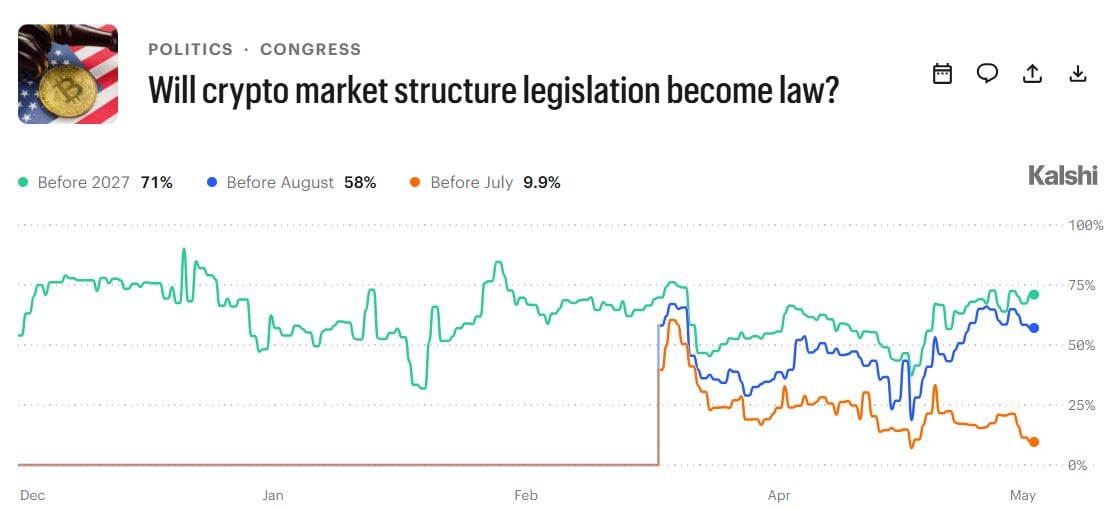
Kalshi’s market on whether crypto market structure legislation will become law now puts the “before 2027” outcome at 71%, according to the latest market screen. The same market prices a 58% chance of passage before August and only a 9.9% chance before July, showing that traders see a real 2026 path but are not pricing an immediate final vote as the base case.
The move comes after the CLARITY Act cleared the Senate Banking Committee in a 15-9 vote, giving the Digital Asset Market Clarity Act its strongest Senate momentum so far. The bill is designed to create clearer federal rules for digital assets, including when tokens fall under Securities and Exchange Commission oversight, when they fit into Commodity Futures Trading Commission lanes, and how crypto intermediaries should register and operate.
That progress has pushed the bill from a policy debate into a calendar and coalition fight. A 71% prediction-market price does not mean passage is locked. It means traders are assigning stronger odds that lawmakers can turn committee support into final legislation before the 2026 window closes.
Senate Math Is Still The Hard Part
The committee vote gave the bill a bipartisan headline, but the floor path remains more difficult. Republicans supported the measure, while Democratic Senators Ruben Gallego and Angela Alsobrooks joined them in committee. Both Democratic votes mattered because the bill will likely need broader support if it faces a 60-vote Senate threshold.
That is where the market’s split pricing becomes useful. The 58% odds before August suggest traders think a summer push is plausible, especially if Senate leadership moves quickly. The much lower 9.9% odds before July show that final passage is still expected to take negotiation, floor time, and alignment across committees.
The bill still faces unresolved fights over anti-money-laundering safeguards, stablecoin reward language, DeFi treatment, developer protections, market-maker rules, and ethics restrictions tied to elected officials with crypto-linked business interests. Those issues are not side debates. They are the pressure points that could decide whether the final bill can attract enough Democratic votes without losing crypto-sector or banking-sector support.
Recent CLARITY Act coverage has already pointed to the same sequence: Senate Banking approval, Senate Agriculture alignment, floor negotiations, House reconciliation, and then a final signature.
Why Crypto Markets Care
For crypto firms, the bill matters because it could replace years of enforcement-driven uncertainty with statutory market structure. Exchanges, custodians, token issuers, market makers, brokers, and DeFi front ends all have direct exposure to how the final text defines digital commodities, investment-contract assets, custody duties, registration paths, and secondary-market trading.
For investors, the impact is less about one headline rally and more about market plumbing. A clearer SEC-CFTC split could reduce listing risk, improve institutional comfort, and make compliance costs easier to model. It would not remove regulatory risk, but it could give the U.S. crypto market a more workable rulebook than the current patchwork.
Kalshi’s 71% price now reflects that improved path, but the bill is not at the finish line. The next concrete test is whether lawmakers can turn a 15-9 committee vote into a floor coalition, settle the stablecoin and ethics language, and keep the House aligned with the Senate version before the 2026 legislative clock runs out.
The post Kalshi Puts CLARITY Act 2026 Passage Odds At 71% After Senate Vote appeared first on Crypto Adventure.