Corporate Ethereum Reserves Near Bitcoin Treasury Share As ETH Accumulation Broadens



Corporate Ethereum accumulation has moved into the same supply-share conversation as the Bitcoin treasury trade, with public-company ETH holdings now sitting above 7 million tokens as more firms treat ether as a balance-sheet asset.
The latest Coinglass strategic Ethereum reserve chart places the tracked ETH reserve near 7.33 million ETH, while CoinGecko’s public-company treasury tracker lists 32 companies holding about 7.2 million ETH worth roughly $15.7 billion. That equals nearly 6% of Ethereum’s total supply, close to the corporate Bitcoin treasury share when measured by asset supply rather than dollar value.
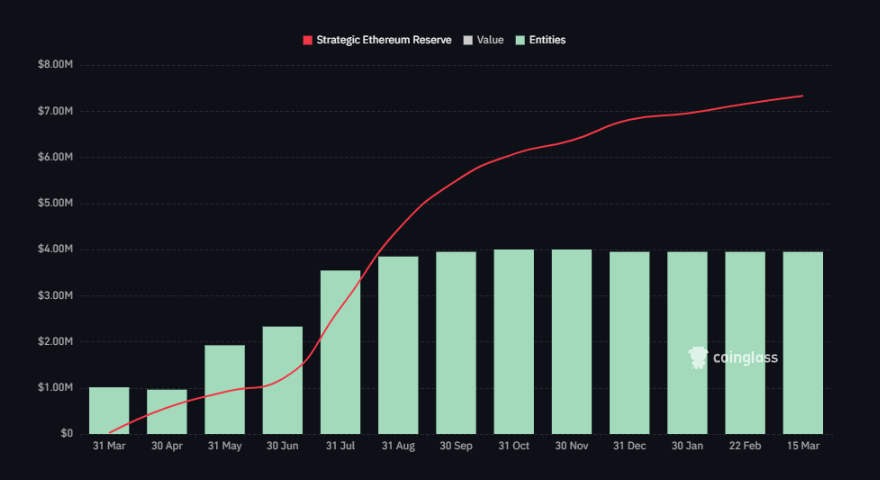
The concentration is led by a small group of public-market ETH vehicles. BitMine said its holdings reached 5.18 million ETH as of May 3, representing 4.29% of supply using the company’s 120.7 million ETH reference. SharpLink reported 872,984 ETH as of May 4, including native ETH and liquid-staking positions, while The Ether Machine holds about 496,712 ETH.
CryptoAdventure previously tracked how BitMine’s ETH buying pushed the company closer to its 5% supply target, turning one corporate balance sheet into a major factor for Ethereum float, staking participation and institutional narrative.
Bitcoin Built The Playbook, Ethereum Changes The Economics
The parallel with Bitcoin is direct but imperfect. Public companies hold about 1.17 million BTC worth more than $91 billion, or 5.58% of Bitcoin’s fixed 21 million supply. Strategy dominates that category with more than 818,000 BTC, making the Bitcoin treasury trade far larger in dollar terms and more mature in capital-market structure.
Ethereum’s treasury market is smaller, but its supply share is already similar. The difference is what companies can do with the asset after buying it. Bitcoin treasuries generally revolve around scarcity, custody, financing and leverage. Ethereum treasuries can also involve staking rewards, liquid-staking tokens, validator exposure and DeFi deployment, adding yield potential along with smart-contract, liquidity and withdrawal-risk layers.
That distinction is already visible in company disclosures. BitMine said more than 4.36 million ETH was staked as of May 3, while SharpLink said it had generated 18,800 ETH in staking rewards since launching its Ethereum treasury strategy. Earlier CryptoAdventure coverage noted that BitMine’s staking push made the ETH treasury model structurally different from Bitcoin accumulation, because the balance sheet can become part of Ethereum’s validator economy rather than only a passive reserve.
The market impact now sits in two places: liquid supply and equity-market risk. More corporate ETH reduces immediately available float if holdings stay locked, staked or treasury-controlled. At the same time, shareholders are taking concentrated exposure to ETH price swings, staking yields, dilution risk, liquidity needs and management execution. Bitcoin created the treasury template, but Ethereum is testing whether a corporate reserve can also function as productive onchain capital.
The post Corporate Ethereum Reserves Near Bitcoin Treasury Share As ETH Accumulation Broadens appeared first on Crypto Adventure.