Kraken Parent Payward Cuts 150 Jobs As IPO Pressure Builds


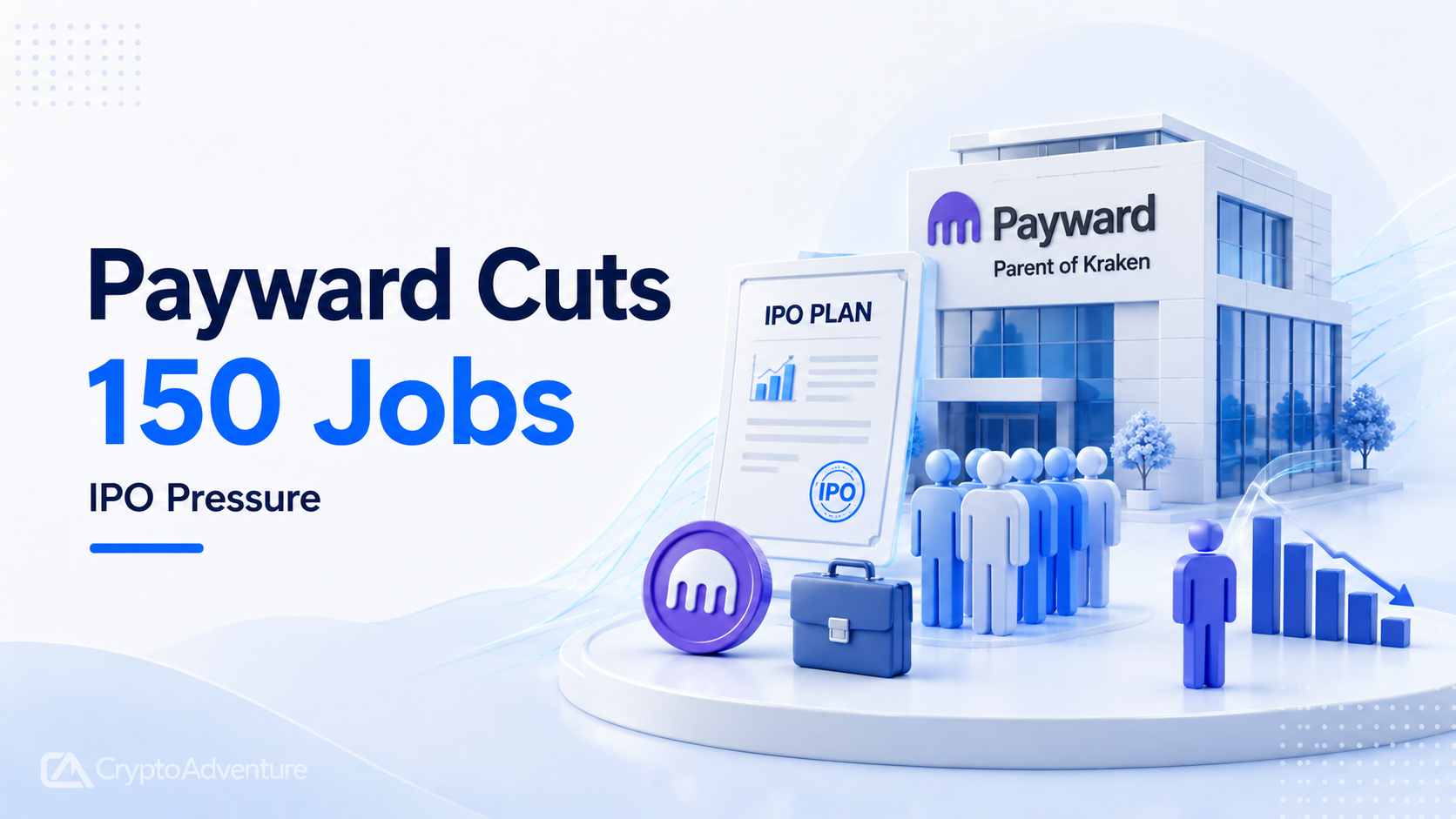
Payward, the parent company of Kraken, is cutting about 150 jobs as the crypto exchange operator continues restructuring ahead of a planned IPO. CoinDesk reported the reduction, citing two people familiar with the matter, and said the cuts are part of an optimization effort at a company with roughly 3,000 employees globally.
The move represents about 5% of Payward’s workforce. It is smaller than Kraken’s earlier wave of reductions, but it lands at a sensitive point for the business. Kraken has already submitted a confidential draft registration statement to the U.S. SEC for a proposed public listing, and the company is still trying to balance IPO readiness with a heavier acquisition and product-expansion cycle.
Kraken’s cost discipline has been building for more than a year. Reuters previously covered role reductions and team consolidation at the exchange, including a company statement that Kraken was reducing redundancies while continuing to hire in key areas. That followed a 2024 reduction of about 400 employees after Arjun Sethi became co-CEO alongside Dave Ripley.
The latest cuts suggest Payward is still removing overlap while trying to present a cleaner operating profile to investors. Public-market investors are likely to focus on revenue quality, margin durability, compliance costs, legal risk and whether Kraken’s fast expansion can operate as one financial platform rather than a loose collection of acquired products.
Crypto Exchanges Are Tightening Costs Again
Kraken is not the only major exchange group trimming headcount while chasing a sharper public-market or investor story. Coinbase also recently cut jobs, adding to a wider pattern of crypto companies trying to protect margins while expanding into new regulated products, payments, derivatives and institutional services.
That context matters because exchange operators are no longer being valued only on spot-trading volume. Investors are looking at cost control, legal exposure, product diversification and whether growth businesses can support more predictable revenue. The recent Coinbase job-cut story showed a similar tension between expansion and discipline: large crypto platforms want to keep building through the next institutional cycle, but they are also trying to avoid carrying bull-market cost structures into a more competitive fee environment.
For Kraken, the 150-person reduction fits that same operating logic. The company is still hiring and investing where it sees strategic value, but duplicated functions and integration-heavy teams become harder to defend before a listing. IPO investors usually reward growth more when it comes with cleaner margins, simpler reporting lines and a clear explanation of how new product lines improve the core business.
Kraken Keeps Buying Infrastructure
The job cuts come as Payward continues spending heavily on market infrastructure. Kraken has pushed beyond spot crypto trading into futures, tokenized stocks, payments, custody-adjacent services and automated trading tools. That expansion has made the company one of the more aggressive private crypto exchanges trying to bridge digital assets with traditional finance.
The clearest example is derivatives. Payward agreed to acquire Bitnomial for up to $550 million, adding a CFTC-regulated designated contract market, derivatives clearing organization and futures commission merchant. The deal followed Kraken’s larger NinjaTrader acquisition and earlier U.S. derivatives moves, giving the company more regulated access to futures traders.
Kraken has also been building tokenized equity distribution through xStocks, while its broader product set now includes equities, ETFs, crypto, payments and derivatives. That strategy makes the company harder to value like a standard crypto exchange. It is increasingly pitching itself as a multi-asset financial infrastructure business, where trading, settlement, tokenization and custody-like workflows sit inside one account system.
That ambition also raises execution risk. Acquisitions can accelerate licensing and product coverage, but they also create integration costs, overlapping roles and duplicated operating layers. A workforce cut before an IPO can therefore be read as a margin-improvement step, but also as a sign that the company is still digesting its rapid buildout.
Valuation Depends On Growth And Discipline
Payward is also seeking fresh funding at a $20 billion valuation, according to CoinDesk. That figure matches the valuation attached to Kraken’s late-2025 capital raise, when the company raised $800 million across two tranches and disclosed a $200 million strategic investment from Citadel Securities at a $20 billion valuation.
The IPO path has not been straight. Reuters reported in March that Kraken had paused its public-listing plans because of market conditions, while still considering an IPO later. Since then, stronger crypto policy momentum, exchange consolidation and renewed investor appetite for digital-asset infrastructure have kept the window open.
The latest 150-person cut puts Payward’s IPO preparation into a clearer frame: grow the platform, control headcount, simplify duplicated functions and preserve the valuation story before investors see the full S-1. The next measurable signals are whether fresh funding closes near the targeted valuation, whether Bitnomial and NinjaTrader integration stays on schedule, and whether Kraken can show that its multi-asset expansion is improving margins rather than only increasing complexity.
The post Kraken Parent Payward Cuts 150 Jobs As IPO Pressure Builds appeared first on Crypto Adventure.