META Stock Price Forecast: Breakdown Puts $557 In Focus As AI Spending Fears Grow


Meta stock is back under pressure after a sharp weekly decline broke a bearish technical setup and renewed concerns about the company’s rising AI infrastructure bill.
META closed near $593 on June 5 after falling 5.51% on the day, with an intraday low near $583 and volume above 30 million shares. The move extended a rough week for the Facebook and Instagram parent, which has been trading far below its 52-week high of $796.25 while investors debate whether Meta’s AI spending can turn into enough revenue to justify the cost.
Technical analyst Ali Martinez flagged the latest breakdown in a META chart update, saying the stock declined 5.83% over the past week and broke down from a right-angled ascending broadening wedge. His downside target sits at $557, while $605 now acts as the key invalidation level.
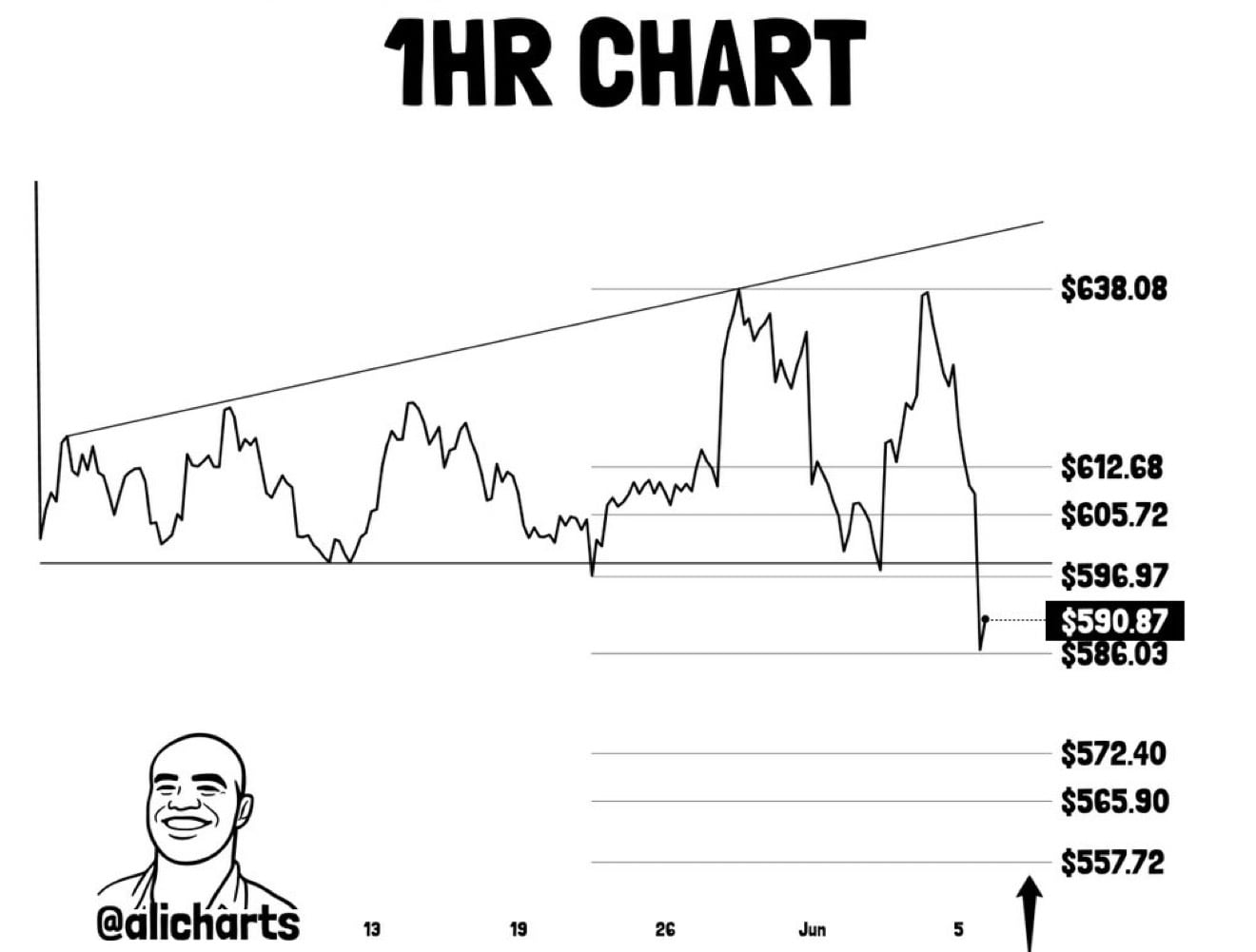
That gives traders a simple near-term map. As long as META trades below $605, the breakdown remains active and the $557 zone stays in play. A clean recovery above $605 would weaken the bearish setup and shift attention back toward the $620 to $630 area, where the latest selloff began.
AI Spending Remains The Main Pressure Point
The technical weakness is happening because the fundamental story has also become more fragile. Meta’s Q1 2026 results were strong on the surface, with revenue rising 33% year-over-year to $56.31 billion, operating income reaching $22.87 billion, and Family daily active people averaging 3.56 billion in March.
The issue is not growth. It is spending.
Meta reported $19.84 billion in first-quarter capital expenditures and guided for full-year 2026 capex of $125 billion to $145 billion. That higher spending range already triggered a sharp shareholder reaction, with META losing $175 billion in market value after its AI expense update.
The latest pressure intensified after reports that Meta could explore a large stock offering to help fund AI infrastructure. Meta has pushed back on that report, but the market reaction was clear. Investors are increasingly sensitive to dilution risk, data-center costs and whether Big Tech’s AI race is becoming too capital intensive even for the world’s richest technology companies.
That concern was also visible when Meta dropped as stock-sale fears deepened the AI spending debate. The selloff was not only about one financing rumor. It reflected a broader shift in how investors are treating AI hyperscalers that need massive compute, power, chips and data-center capacity.
Wall Street Still Sees Upside, But The Targets Are Split
The near-term chart is bearish, but Wall Street’s 12-month view remains far more constructive. MarketBeat’s analyst tracker places Meta’s average 12-month target near $840.60, with a high forecast of $1,015 and a low forecast of $700. The consensus sits at Moderate Buy, with 35 Buy ratings, 3 Strong Buy ratings, 9 Hold ratings and 1 Sell rating.
Benzinga’s analyst tracker shows a similar picture, with a $834.43 consensus target, a $1,015 high target from Rosenblatt and a $700 low target from Scotiabank. RBC Capital recently reiterated an Outperform rating with an $810 target, while Wells Fargo kept an Overweight rating after trimming its target to $765.
Morgan Stanley’s Brian Nowak has kept Meta as a top pick with a $775 target, pointing to AI-powered search, subscription potential, better ad tools and the possibility that Meta could eventually monetize excess data-center capacity. Bank of America’s broader tech view is more cautious, favoring AI “capex takers” such as semiconductors and hardware over the biggest AI spenders, including Meta, Alphabet and Oracle.
That split explains the current stock action. Analysts still like Meta’s core business, ad machine, user base and long-term AI optionality. Traders are focused on the next few weeks of price action, the cost of AI infrastructure and whether shareholders will tolerate more capital intensity before the revenue payoff is obvious.
META Stock Forecast: $557, $605 And $630 Are The Key Levels
META’s short-term forecast now depends on whether buyers can defend the post-breakdown range.
The bearish case is straightforward. If META stays below $605 and sellers keep control, the $557 target from the wedge breakdown becomes the next major downside zone. That would place the stock closer to its 52-week low area and likely deepen concerns around AI capex, dilution risk and weak tech momentum.
The base case is choppy consolidation between $557 and $605. That would allow the stock to absorb the latest selloff while investors wait for clearer evidence on AI monetization, capex discipline and whether the stock-offering concerns fade.
The bullish case needs a recovery above $605 first. A sustained move back above that level would invalidate the immediate bearish chart and open room toward $620 to $630. Above that zone, traders would likely watch whether META can rebuild momentum toward the mid-$600s, where analyst confidence and technical recovery would start to align again.
Meta is not being sold because its core business is broken. The company is still producing enormous revenue, high operating income and unmatched social-media reach. The market is repricing the cost of staying ahead in AI. Until META reclaims $605 or shows that AI spending can convert into clear earnings power, the stock remains vulnerable to another test of $557.