Binance Stablecoin Reserves Jump To 28% As Digital Dollars Move Beyond Trading

Stablecoins now account for 28% of Binance’s total exchange reserves, up from 16%, highlighting how digital dollars have become a larger part of the crypto market’s core liquidity base.
The latest Binance Research reading points to a structural change in how users hold value on exchanges. The shift is not only a short-term move into cash during a market drawdown. The higher stablecoin share has persisted across different market cycles, suggesting that users are increasingly holding stablecoins for reasons beyond waiting to buy Bitcoin or altcoins.
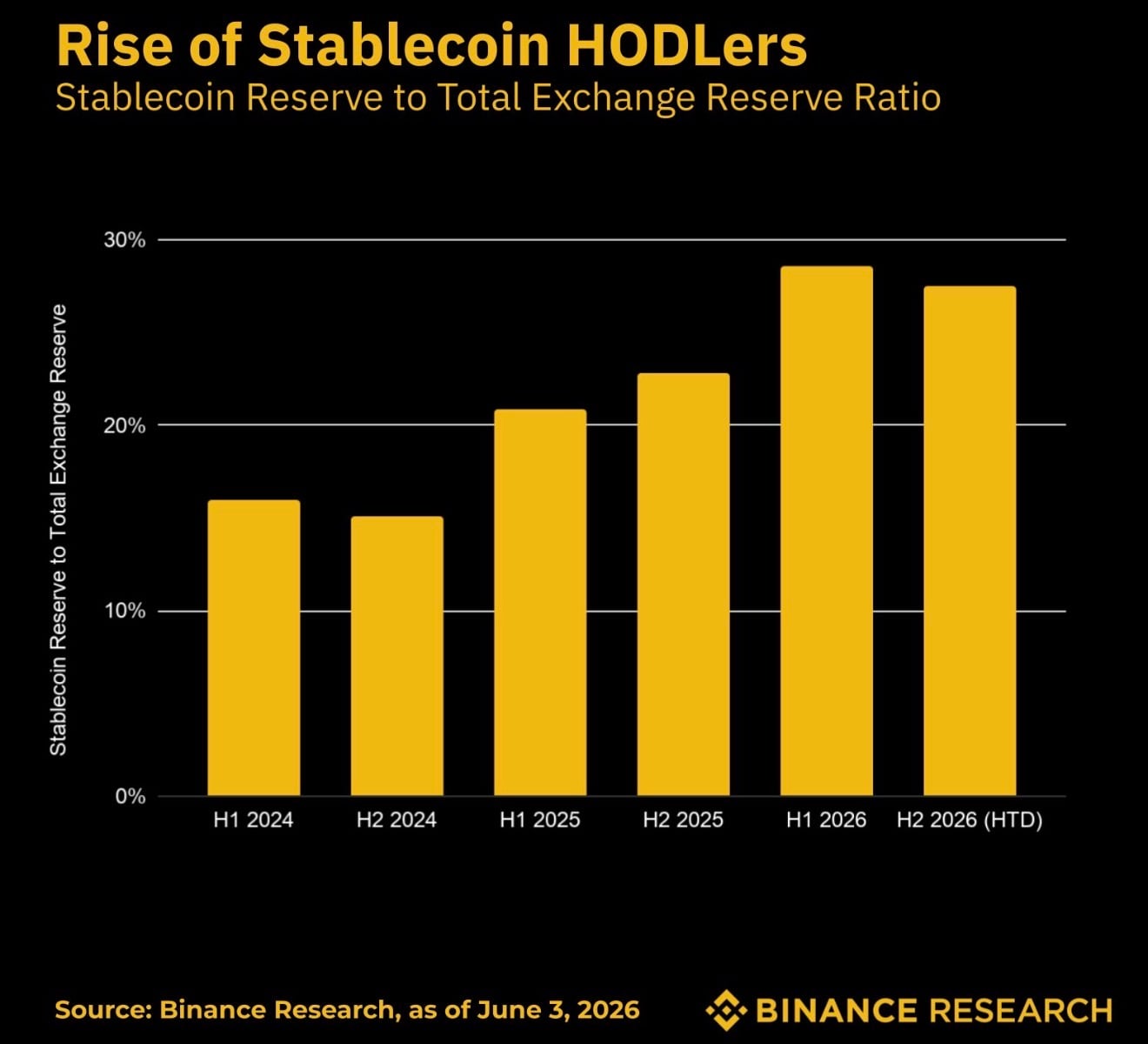
That distinction matters. Exchange stablecoin reserves can rise during panic because traders sell volatile assets and park capital in USDT, USDC or other dollar-linked tokens. But when the stablecoin share remains elevated across rallies, corrections and sideways markets, it points to a deeper change in user behavior.
Stablecoins are no longer just the waiting room between trades. They are becoming a preferred balance asset for yield strategies, payments, transfers, payroll, remittances, collateral and digital-dollar savings.
This Is Not Just A Risk-Off Signal
A rising stablecoin share can still reflect caution. Bitcoin has been under heavy pressure, ETF flows have weakened, and traders have been moving away from high-beta altcoin exposure. In that environment, more stablecoin balances on Binance would normally be read as dry powder or defensive positioning.
The persistence of the trend changes the interpretation. Users who keep stablecoins on exchanges through multiple market regimes are not only avoiding volatility. They are using exchanges as liquidity hubs for dollar-like assets that can move quickly across chains, products and counterparties.
That fits the broader market shift. The total stablecoin market remains above $317 billion, with USDT holding roughly 59% dominance on DeFiLlama’s stablecoin dashboard. Binance Research’s own stablecoin business report frames the sector as moving from a crypto-trading tool into a global medium for digital savings and payments, with total stablecoin market capitalization having crossed $300 billion in 2025.
The same expansion is visible outside exchange balances. Stablecoins are increasingly tied to merchant settlement, cross-border transfers, fintech apps and payment networks. The market already has a broader stablecoin supercycle thesis because the growth engine now includes payments, remittances, tokenized assets and app-level distribution, not only trader liquidity.
Stablecoins Become Exchange Infrastructure
For Binance, a higher stablecoin reserve share means more than users sitting in cash. Stablecoins are the settlement layer for spot trading, derivatives collateral, launch activity, transfers between exchanges, DeFi access and fiat-like account balances.
That makes them closer to exchange infrastructure than a single asset category. A user can hold USDT or USDC, move across chains, deploy into yield, post collateral, fund a trade, withdraw to a wallet or send value internationally without switching back into a bank account.
This is also why payment companies and crypto exchanges are moving toward deeper stablecoin integration. The planned Stripe, Visa, Mastercard and Coinbase stablecoin consortium shows how the fight is shifting from exchange liquidity into payment-network control. The same logic applies on exchanges: the more users hold stablecoins intentionally, the more stablecoins become the default operating balance for crypto finance.
Stablecoin payment systems are also becoming more complex. Serious stablecoin payment rails now involve wallets, issuers, blockchains, payment processors, settlement accounts, compliance checks and merchant systems. That infrastructure buildout makes stablecoins useful even when users are not actively trading.
The Reserve Mix Shows A Bigger Market Shift
The Binance reserve mix should not be confused with issuer reserves. This is not a statement about the assets backing USDT, USDC or any other stablecoin. It is a measure of stablecoins as a share of assets held on the exchange.
That still makes the signal important. Exchanges sit at the center of crypto liquidity. When stablecoins grow from 16% to 28% of Binance’s total holdings, the market is showing that digital dollars are taking a larger share of user balances, collateral and settlement activity.
The risk is that stablecoin concentration can make markets more dependent on issuer trust, redemption access, chain reliability and regulatory treatment. The benefit is that stablecoins give users a faster, more programmable dollar-like asset than traditional bank money can usually provide inside crypto markets.
The larger story is no longer that traders are parking funds between trades. Stablecoins have become a balance sheet product, a payments rail, a transfer tool and a store-of-value substitute for users who want dollar exposure without leaving crypto infrastructure. Binance’s reserve mix makes that shift harder to ignore.