Berkshire Hathaway Underperformance Revives Financial Crisis Comparisons


Berkshire Hathaway’s Class A shares are underperforming the S&P 500 by a margin compared with the run-up to the Global Financial Crisis, bringing one of Wall Street’s most closely watched defensive stocks back into the market-risk debate.
The latest Barchart comparison places BRK.A’s relative weakness near the same type of spread seen before the 2008 crisis. The chart does not signal a confirmed crisis by itself, but the level of underperformance is drawing attention because Berkshire is usually treated as a high-quality balance-sheet stock that can hold up when investors reduce risk.
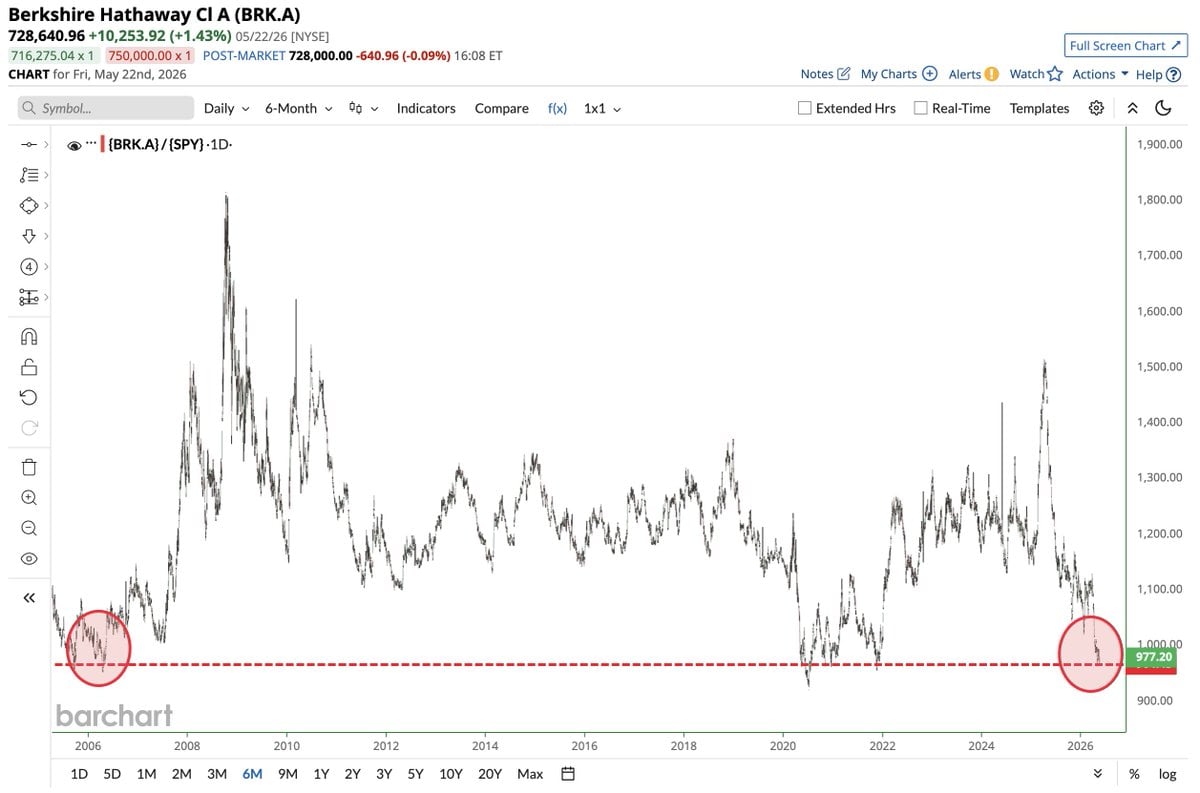
Berkshire traded near $728,641 in the latest market data, while the SPDR S&P 500 ETF Trust traded near $745.64. The relative gap has widened as large-cap index strength remained concentrated in faster-moving growth and technology names, while Berkshire’s more defensive business mix lagged the broader benchmark.
The move comes during a fragile macro stretch for risk assets. U.S. consumer sentiment fell to 44.8 in May as inflation expectations rose, adding another pressure point for investors already watching oil, rates and household demand.
Buffett Premium Faces A Tougher Market
Berkshire’s underperformance also lands during the company’s leadership transition. Warren Buffett announced in 2025 that Greg Abel would take over as CEO, ending a six-decade run that made Berkshire one of the most influential capital allocators in global markets.
The company still has one of the strongest balance sheets in public markets. Berkshire’s latest first-quarter filing showed a massive cash and Treasury-bill position, giving it flexibility if asset prices fall or acquisition opportunities return.
That cash position can also weigh on performance when the S&P 500 is rising. A large Treasury-heavy balance sheet protects downside and preserves optionality, but it does not keep pace with a market rally driven by AI, mega-cap technology and momentum-heavy sectors.
The concern for investors is the timing. Berkshire’s relative weakness is appearing while inflation expectations are rising, consumer confidence is low and rate-cut expectations remain unstable. Crypto markets are tracking the same liquidity backdrop, with the latest crypto market snapshot showing Bitcoin holding above $77,000 as traders watched whether macro pressure would ease.
Risk Signal Hits Broader Markets
Berkshire’s lag does not mean the S&P 500 is about to repeat 2008. It does show that investors are no longer rewarding defensive quality in the same way while index performance stays tied to a narrow group of growth leaders.
That type of split can become important when liquidity tightens. If the strongest stocks stop carrying the index, underperformance in defensive names can turn from a relative-performance issue into a broader market warning.
For Bitcoin and crypto, the read-through is mainly about risk appetite. A market that ignores defensive weakness can keep rising as long as liquidity remains supportive. A market that begins repricing growth, earnings and policy risk at the same time can quickly pressure leveraged crypto trades, altcoins and speculative flows.
The next signals are BRK.A’s relative performance against the S&P 500, Treasury yields, incoming inflation data and whether market leadership broadens beyond the largest growth stocks. Berkshire’s weakness is not a crisis call, but it is now part of the same macro dashboard traders are watching across equities, Bitcoin and high-risk assets.
The post Berkshire Hathaway Underperformance Revives Financial Crisis Comparisons appeared first on Crypto Adventure.